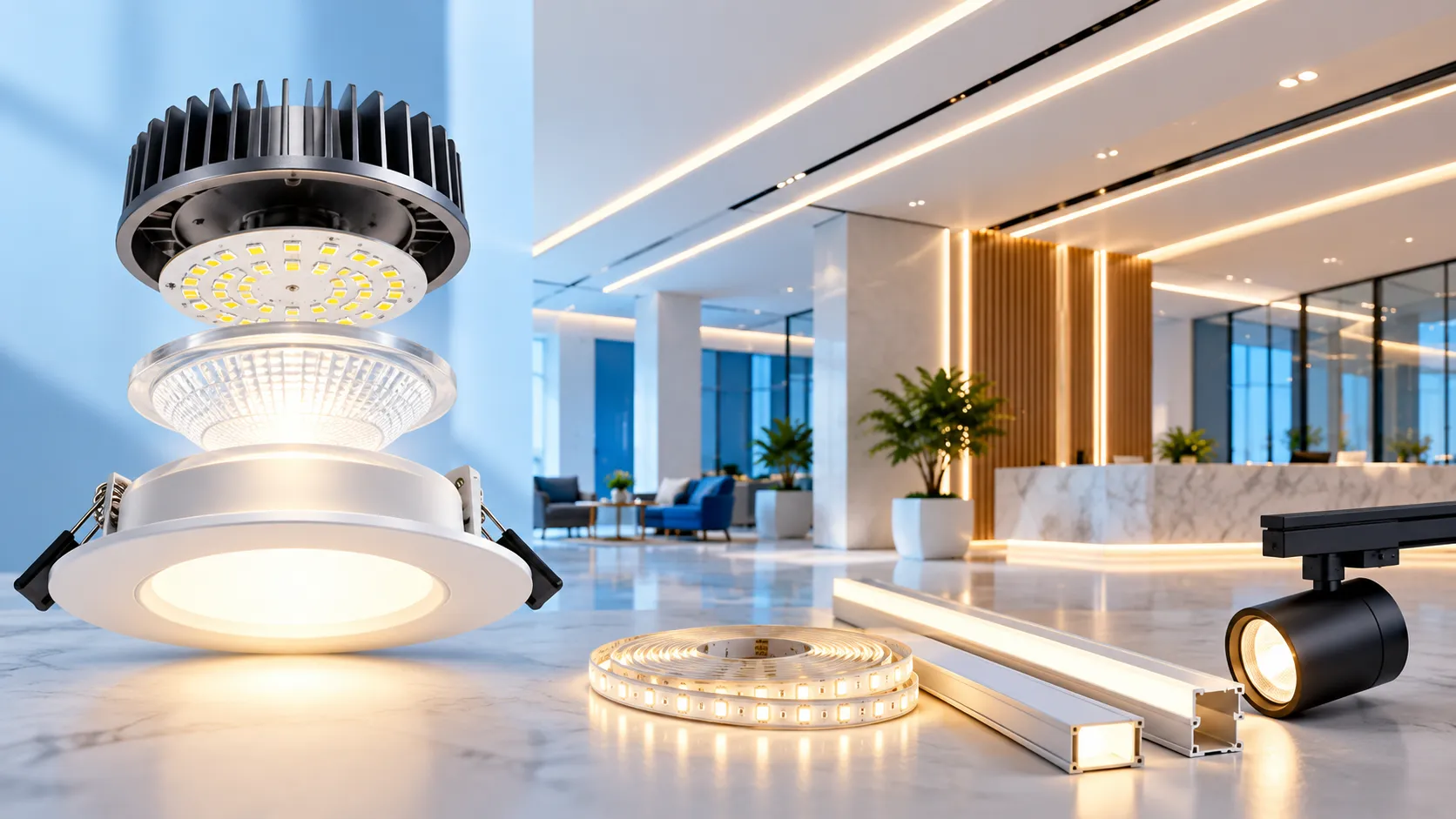
What Is LED Lighting?
LED stands for Light Emitting Diode. LED lighting produces illumination by passing electrical current through a semiconductor material, which generates light.
Unlike traditional lighting technologies that rely on heating a filament or using gas discharge, LEDs use semiconductor technology to produce light.
Today, LED lighting is widely used in homes, offices, hotels, retail stores, industrial facilities and architectural projects.
In the UAE and wider Gulf region, LED solutions are particularly common in commercial developments because they are available in a wide range of designs and applications.
How Does LED Lighting Work?
An LED contains a semiconductor that emits light when electrical current passes through it.
Because LEDs operate differently from traditional incandescent bulbs, they can be designed into compact fixtures and integrated into architectural elements.
An LED lighting system typically includes the LED itself, optical components, thermal management components and, depending on the product, a driver or control system.
The combination of these components determines the fixture's performance and application.
Why Is LED Lighting Popular?
LED technology offers flexibility in terms of design and application.
LED fixtures are available as:
Downlights
Spotlights
Linear profiles
LED strips
Track lights
Panel lights
High-bay fixtures
Decorative lights
Outdoor architectural lighting
This variety allows designers and contractors to select solutions based on the requirements of individual spaces.
What Are the Benefits of LED Lighting?
One important benefit of LED technology is its potential for energy efficiency compared with many older lighting technologies.
LED fixtures can also provide long operating life when properly selected, installed and maintained.
Other advantages include:
Design flexibility: LEDs can be manufactured in different sizes, shapes and configurations.
Directional lighting: Many LED fixtures can direct light toward specific areas.
Colour options: LEDs are available in different colour temperatures and colour options.
Dimming and controls: Compatible LED systems can work with dimming and lighting control technologies.
Architectural integration: LED strips and profiles can be incorporated into ceilings, walls, furniture and other architectural features.
What Is LED Lighting Used For?
LED lighting can be used for almost every major lighting application.
In offices, LED lighting can provide general illumination and task lighting.
In retail environments, directional fixtures can highlight products.
Hotels can combine decorative and architectural LED solutions to create atmosphere.
Industrial facilities can use high-bay LED fixtures for large spaces.
Exterior applications can include facade, landscape, entrance and pathway lighting.
LED Lighting for Architectural Projects
Architectural LED lighting has become particularly important in modern interior design.
Linear LED profiles can create continuous lines of illumination across ceilings and walls. LED strips can be integrated into joinery and furniture, while recessed fixtures can provide discreet illumination.
This allows the lighting system to become part of the architecture.
How Do You Choose the Right LED Light?
Choosing the right LED fixture depends on the application.
Consider:
Required brightness
Colour temperature
Colour rendering
Beam angle
Fixture dimensions
Installation method
Dimming requirements
Control systems
Indoor or outdoor location
Environmental conditions
Maintenance access
A lighting professional can help match these requirements to appropriate products.
LED Lighting in the UAE and Gulf
Commercial lighting projects in the UAE and GCC can include offices, retail stores, hotels, restaurants, healthcare facilities, warehouses, villas and large developments.
The correct product selection should account for the building's design, operating conditions and installation environment.
For external projects, protection ratings and environmental exposure should be considered carefully.
Conclusion
LED lighting combines energy-efficient technology with considerable design flexibility. From architectural interiors to commercial exteriors, LED solutions can be adapted to many different applications.
Understanding the basic principles of LED technology makes it easier for architects, designers, contractors and property owners to select suitable lighting solutions for their projects.