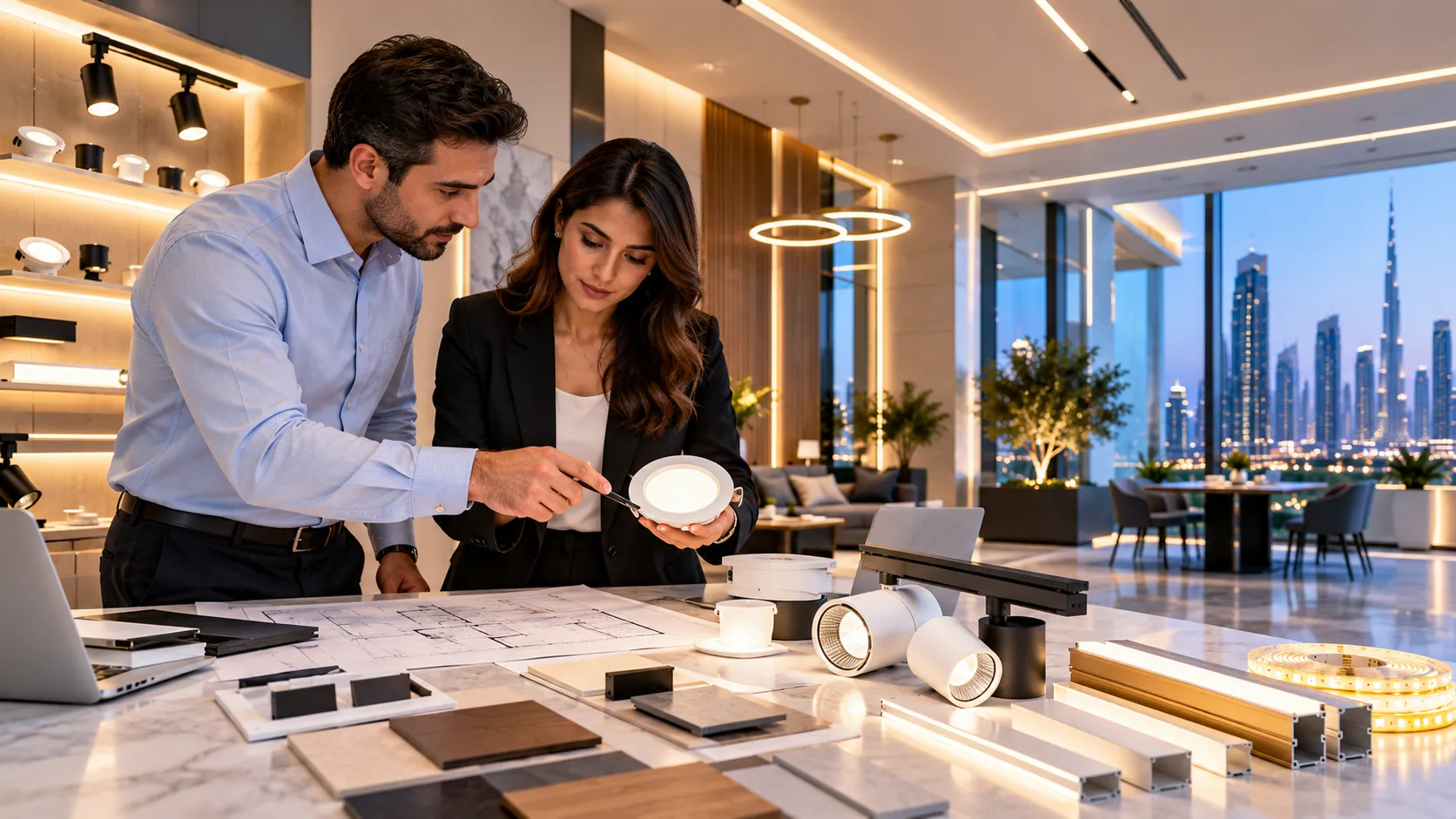
How to Choose the Right LED Light for a Commercial Project
Selecting LED lighting for a commercial project involves more than choosing a fixture based on its appearance. The right lighting solution needs to match the purpose of the space, architectural design, required illumination and operating environment.
Whether the project is an office, hotel, retail store, restaurant, showroom or other commercial facility, several factors should be evaluated before selecting the lighting system.
1. Understand the Purpose of the Space
The first step is identifying how the space will be used.
An office requires comfortable general and task lighting, while a retail store may need directional lighting to highlight products.
A hotel lobby may require a combination of ambient and decorative lighting, whereas a warehouse may prioritise uniform illumination and high output.
2. Select the Appropriate Colour Temperature
Colour temperature influences the appearance and atmosphere of a space.
Warm white lighting can create a comfortable and hospitality-oriented atmosphere.
Neutral white lighting is commonly used in offices and commercial environments where a balanced appearance is required.
Cooler lighting can be suitable for certain functional environments.
The appropriate colour temperature should be selected according to the purpose and design of the space.
3. Consider Lumens Instead of Watts Alone
Wattage indicates energy consumption, while lumens indicate the amount of visible light produced.
When comparing LED fixtures, understanding lumen output is therefore important.
The required lumen level depends on factors such as room size, ceiling height, surface reflectance and the activities taking place in the space.
4. Check Colour Rendering
Colour Rendering Index, or CRI, indicates how accurately a light source reveals colours compared with a reference light source.
High colour rendering can be particularly important in retail, hospitality, galleries, showrooms and other environments where the appearance of products and materials matters.
5. Consider Beam Angle
Beam angle determines how widely light is distributed.
A narrow beam can be useful for highlighting specific objects or architectural details.
A wider beam can provide broader illumination.
Selecting the correct beam angle can help prevent unwanted dark areas or excessive overlap.
6. Match the Fixture to the Architecture
Commercial lighting should work with the architectural design.
For modern interiors, linear LED profiles can be integrated into ceilings and walls. Recessed downlights can provide a discreet appearance, while track lighting can offer flexibility.
For decorative environments, pendant or feature lighting may become an architectural focal point.
7. Consider Lighting Controls
Lighting controls can provide additional flexibility.
Depending on the project, systems may support:
Dimming
Scheduling
Occupancy sensors
Daylight response
Scene setting
Centralised control
For larger commercial developments, lighting controls can form an important part of the overall building strategy.
8. Consider the UAE Environment
For UAE and Gulf projects, the installation environment should be considered carefully.
External fixtures may be exposed to heat, dust and moisture, making appropriate protection and product selection important.
Indoor fixtures should also be compatible with the ceiling construction, ventilation and operating conditions of the space.
9. Plan for Installation and Maintenance
A lighting system should be practical to install and maintain.
Before selecting a fixture, consider access, mounting requirements, driver locations, replacement procedures and the availability of compatible components.
This is particularly important for high ceilings, large commercial buildings and difficult-to-access architectural installations.
10. Work With a Lighting Specialist
For large commercial projects, professional lighting input can help coordinate product selection with architecture, interior design and electrical requirements.
Early collaboration can help ensure that lighting fixtures are properly integrated into the design and that the selected products meet the project's functional and aesthetic requirements.
Conclusion
Choosing the right LED lighting for a commercial project requires consideration of much more than fixture appearance.
The space's purpose, colour temperature, lumen output, CRI, beam angle, architectural design, controls, installation environment and maintenance requirements all play a role.
For commercial projects across the UAE and GCC, a well-planned LED lighting strategy can help create functional, visually appealing and professionally coordinated environments.